
MIYAGI, IWATE, Nov. 21 – “Half-farmer, half-fisher” in the Tohoku northeastern region of Japan are being tossed about by escalating China-Japan political tensions. On the Pacific Coast in the Tohoku region of Japan, some people earn income from both farming and fishing, and they are struck again by the return of China’s ban on marine product imports from Japan. In August 2023, China suspended all Japanese seafood imports after Japan decided to release treated water from the No. 1 Fukushima Nuclear Power Plant into the ocean. However, the ban was lifted partially this year. Therefore, the latest suspension was a big blow.
Hayashi, a fruit farmer and sea cucumber fisher in Miyagi Prefecture: This is like rubbing salt into wounds.
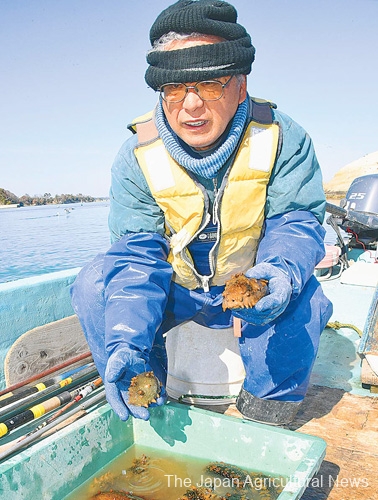
Hayashi is a fruit farmer who also makes his living from sea cucumber fishing. (In Higashi Matsushima City, Miyagi Prefecture)
“I must cut my grocery costs and live meagerly,” Hideo Hayashi, a 77-year-old fruit farmer and sea cucumber fisher in the Miyako region, Matsushima City, Miyagi Prefecture, said. To him, China’s ban on imports was devastating news.
According to Hayashi, most of the sea cucumbers from this region are shipped to China. Sea cucumbers are a luxury foodstuff, but a local fishery official told him that China’s import ban would lead to slower demand and lower prices. “Continuing the import ban is like rubbing salt into the wounds,” he said very disappointedly.
He lives on an island in Matsushima Bay, far from the city. The mountainous island has limited farmland, so many islanders make a living half on farming and half on fishing. Most of the nine members of the Oku Matsushima Fruit Producers Association, to which Hayashi belongs, also work in the fishing industry, with five in sea cucumber fishing.
The head of the association, Yoshihisa Ogata, said, “If this continues, some will probably quit sea cucumber fishing. They may leave the island, and we will have a shortage of farmers.” “This is a matter of life and death for local agriculture,” he continued.
Yokoishi, wagyu cattle grower and awabi (abalone) fisher in Iwate Prefecture: This can end the region.
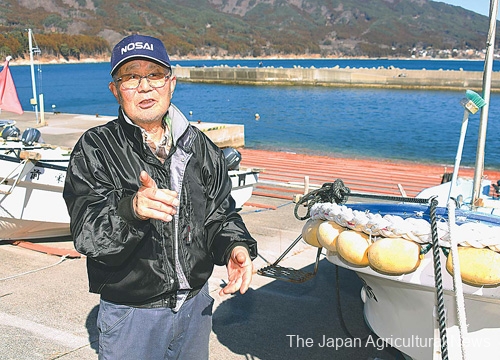
Yokoishi is a cattle breeder and dried abalone producer. (In Ofunato City, Iwate Prefecture)
Yoshinori Yokoishi, 77, is a wagyu cattle breeder and producer of dried Japanese Kippin abalone, known as a luxury ingredient in Chinese cuisine. He lives in the Yoshihama region, Sanriku Town, Ofunato City, Iwate Prefecture. When China suspended seafood imports from Iwate Prefecture due to Japan’s release of treated water, Hong Kong, the primary market for abalone, was out of the scope. According to Yokoishi, the abalone catch has been decreasing each year. “So, the recent ban may have a small impact,” he said.
However, he is also struggling in the farming business. Yokoishi’s income from his small farm in a mountainous area is limited, although beef calf prices have been on the rise this year. “It’s difficult to make a living solely from farming in this area,” he said. The decline in fishing revenues can lead to the end of the region, he fears, saying, “If this continues, Yoshihama’s satoyama natural landscape and living can fall into ruin.”