
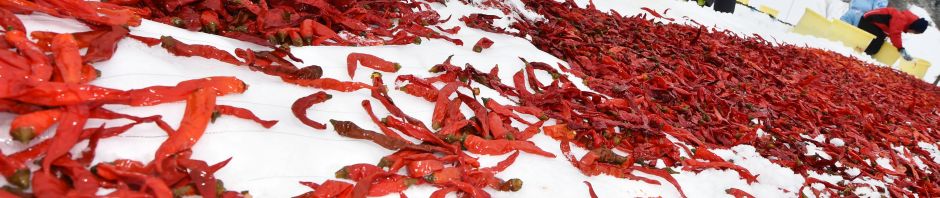
NAGANO, Jan. 19 – The coldest season of the year has come, and so has the busiest season for kakukanten agar bar production in Chino City, Nagano Prefecture. The bars of kanten, neatly placed in a drying area across cold, harvested rice fields, create a unique scene that makes locals feel the coming of winter.
The temperature was at 4 degrees below zero after midnight. At the workshop of Gomi Kiichi Shoten store in Chino, people are boiling and dissolving tengusa seaweed, the raw material for agar, in a huge cauldron nearly three meters in diameter. The room was filled with steam and the distinctive scent of seaweed.
“It’s especially cold today,” said Tetsuya Watanabe (63), who was in charge of boiling tengusa. Back in his hometown in Nishiwaga, Iwate Prefecture, Watanabe produces gentians and rice. In winter, he has no agricultural work in the snow-covered town of Nishiwaga, so he comes to Chino in the first half of November and lives and works in the Kanten Factory until the first half of February. He returns home when the season for aralia sprouts production starts.
At 4 o’clock in the morning, the boiled liquid is strained and poured into shallow boxes (called morobuta) and left to cool and solidify for approximately 2.5 hours. The resulting firm jelly, known as namakanten (raw kanten), is cut by hand and laid outside before sunset. Then it goes into the freeze-drying process, which takes advantage of the temperature difference between day and night. For about two weeks, the blocks are left to repeatedly freeze at night and thaw during the day, slowly expelling moisture to achieve high quality.
The Suwa region in Nagano Prefecture is a dry area with many sunny days, and this dryness and the cold weather make it a suitable place for farmers to produce kanten in winter. Today, there are 10 kanten producers, making the region the No. 1 kanten-producing area in Japan.
Then, why has the production of kanten made from an ocean-based ingredient become a local staple industry in this mountainous region of inland Japan? It is said that a local peddler in the Edo period saw kanten production in the Kansai area, thought it would suit the climate of his hometown, and brought the technique back.
“We want to preserve the tradition of kanten making blessed with local nature for a long time,” Masahiko Gomi, the store representative, stressed.
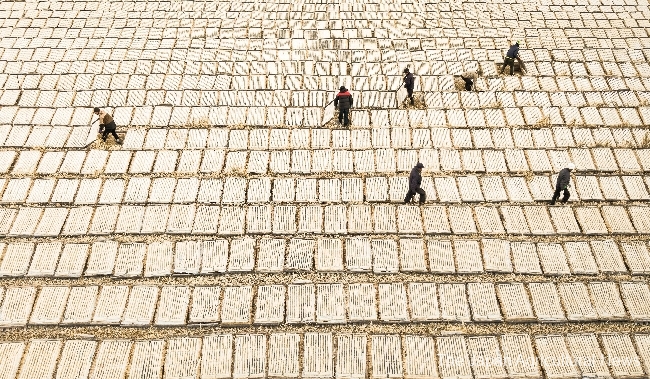
Rice fields in Chino are covered with kakukanten agar bars neatly arranged for sun-drying. (in Chino City, Nagano Prefecture)