
AKITA, Jan. 14 — Takashi Kakinoki, 38, of Noshiro, Akita Prefecture, has been working voluntarily to pick abandoned persimmons and process them into food products such as okonomiyaki savory pancakes and smoothies.
He engages in the activity in hopes of turning neglected persimmon trees in rural villages into valuable resources.
Last year in particular, when Japan saw a record number of bear sightings —with many attracted to fruit-bearing trees in residential areas — he received a number of requests from owners of persimmon trees to harvest the fruit because they don’t want to cut down the trees filled with memories.
Kakinoki, a native of Hiroshima Prefecture, moved to Noshiro, his wife’s hometown, in 2018 and worked for a printing company for three and a half years.
After seeing many persimmon trees abandoned in the rural community, he came to feel that he wants to transform them into valued resources.
In 2022, he started a business of harvesting persimmons on behalf of the trees’ owners, processing them into food items and selling them.
He said the fact that his last name Kakinoki means “persimmon tree” in Japanese also instilled in him a sense of mission.
The number of requests from tree owners had hovered between 20 and 25 a year since 2022, but grew to more than 60 last year.
The amount of harvest was roughly 3 tons, tripling from an average year.
The requests surged as abandoned persimmons have become a significant attractant for bears, while many owners are reluctant to cut down the trees which have been nurtured for generations.
Kakinoki became a beloved figure in the community, being nicknamed Kakkii.
He harvests persimmons for free and earns an income by using them in making food items such as okonomiyaki and smoothies and selling them on a food truck and at local events.
Some of the processing tasks — including peeling the fruit’s skin to make dried persimmons, packaging the products and putting stickers on them — are entrusted to local senior living facilities and welfare facilities.
He also organizes programs focusing on working with the community, such as holding classes for junior high school students to experience harvesting persimmon leaves.
There have been challenges, however, as many requests involve picking persimmons in vacant lots in mountainous areas where bears are often spotted.
“I feel the risk all the time when I’m working,” Kakinoki said. “To be honest, my hands tremble.”
The other challenge is how to make the business work. Since the business is currently in the red, he plans to increase profits by developing new products and expanding sales channels.
“My motto is to do something that others don’t do,” said Kakinoki, smiling. “Support from local people drives me to carry on.”
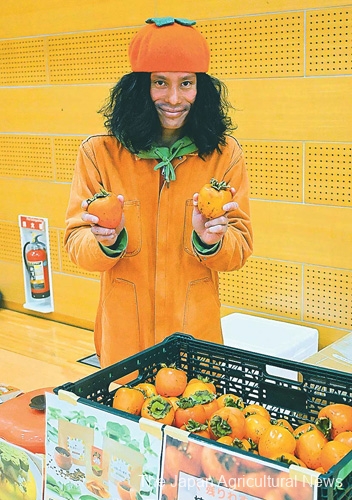
Takashi Kakinoki, dressed in a costume depicting a persimmon, holds abandoned persimmons in the city of Akita.