
OKAYAMA, Jan. 6 — Japan is the world’s fourth biggest consumer of coffee in terms of volume, but it imported 36,0287 tons of green coffee beans in 2024 while the annual domestic production is estimated to be only about 10 tons.
Attempts have been made in recent years to establish a production base for coffee beans in the country, which has a high demand for the product but produces a very small quantity of its own.
A company in Okayama Prefecture newly set up a coffee production division, aiming to harvest a maximum of 500 kilograms of green coffee beans in a few years when its coffee trees mature.
It hopes to expand production in the future to make the produce the new local specialty.
Nakahara Sanpoudo, a company based in Kurashiki, Okayama Prefecture, which sells Buddhist altars and altar fittings, set on cultivating coffee trees in 2023 as part of its new business.
It grows 50 trees on a 7-are greenhouse and conducted the first harvest in 2024.
In 2025, it harvested roughly 10 kg of coffee cherries containing coffee beans by December.
The harvesting period lasts until March this year and the firm expects the total amount of harvest will reach 30 kg.
It aims to harvest 300 to 500 kg on the 7-are land in a couple of years when the trees become fully productive.
Coffee trees are usually grown outdoors and are primarily suited for cultivation in tropical and subtropical countries such as Brazil, Columbia and Vietnam.
In order to produce coffee beans in Japan, it is crucial to grow the trees in similarly warm regions like Okinawa Prefecture or in greenhouses.
The firm’s greenhouse is kept at temperatures between 13 and 35 degrees Celsius and a humidity of between 60 and 70 percent.
Side windows are opened and irrigation management work is done a few times a week.
Yasuhiro Takao, 38, in charge of cultivation, said coffee trees “don’t require much time and effort compared to other fruit trees, and their merit is that there isn’t much work to do except during the harvesting period.”
“If we can eventually make this place a coffee producing region, we can contribute to the local community,” he said.
Yamako Farm, a coffee farm based in the city of Okayama, which offers knowhow on coffee cultivation including pruning instructions, purchases the coffee beans harvested by Nakahara Sanpoudo at more than 30,000 yen per kg, processes the beans and sells them.
The farm also sells coffee seedlings and has in recently years been receiving inquiries from farmers and companies interested in coffee cultivation.
Kosuke Yamamoto, head of Yamako Farm, said, “Domestically produced coffee has great value and there is a good deal of demand for the product.”
Yamako Farm sells Japan-made Typica, a variety of arabica coffee considered rare and highly valued.
Its rich aroma, as well as its fragrant and clear flavor, is popular even among foreign buyers.
Domestic coffee bean production is slightly increasing, mainly due to coffee trees grown outdoors in Okinawa Prefecture.
According to the Okinawa Coffee Association’s compiled data, the amount of green coffee beans produced in the prefecture was 6 to 8 tons in 2024, up some 30 percent from 2023.
The total amount of domestic production is estimated to be around 10 tons.
However, challenges remain in coffee production in Japan, including high initial costs, as coffee tree cultivation outside Okinawa requires strongly-built greenhouses that can keep the temperatures inside at 10 degrees Celsius or more throughout the year.
International statistics show that Japan’s annual coffee consumption was ranked fourth worldwide in 2024 at 400,218 tons and its market size is said to be some 3 trillion yen.
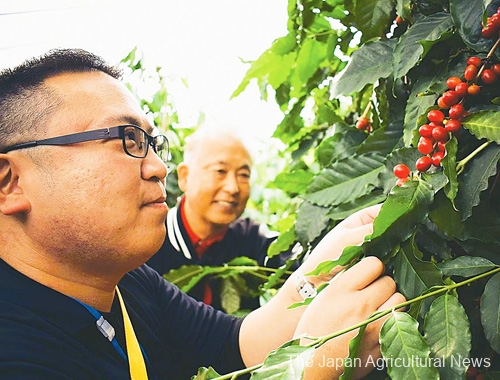
Yasuhiro Takao (left) and Kosuke Yamamoto harvest coffee cherries in Kurashiki, Okayama Prefecture.